DesignVerse raised $5.5m to take humans out of modernization. We think the hard part is still human.
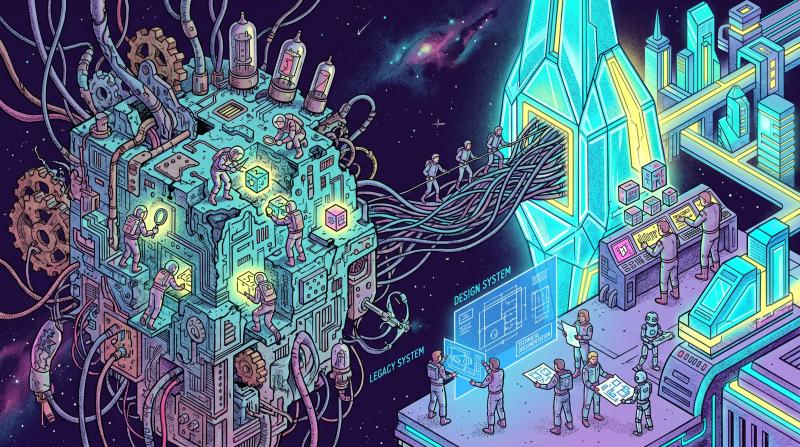
There is a wave of application rebuilding and replacement going on. At Eli5, we review articles about software modernization every week to find real value for CTOs, PMs, and POs who have to deal with the modernization of legacy software. This week we reviewed an announcement from DesignVerse, a Bucharest-based enterprise AI startup that raised $5.5m in seed funding to scale a platform that generates production software from a customer's design system, component library and technical documentation. The press release leans heavily on EUROCONTROL, the Pan-European aviation organisation, as a flagship customer, with the headline claim that the platform modernized a 15-year-old application in just over a month versus an estimated six. The founders, ex-Oracle on the design side and ex-automotive AI on the engineering side, position the product as the responsible alternative to vibe coding for mission-critical enterprise software. The whole pitch sits on one premise: with the right AI platform, the human work in enterprise modernization can be largely engineered away. That premise is what we wanted to test against what we actually see in legacy environments.
Source. AI startup supporting Europe's air traffic management software upgrade raises $5.5m seed funding (Businesswire)
Abstract
DesignVerse, a Bucharest-based enterprise AI startup, raised $5.5m in seed funding to scale a platform that generates production software from a company's design system, component library and technical documentation. The press release leads with EUROCONTROL, the Pan-European aviation organisation, as a flagship customer, claiming the platform modernized a 15-year-old application in just over a month versus an estimated six. The founders, ex-Oracle and ex-automotive AI, position the product as the responsible alternative to vibe coding for mission-critical enterprise software.
Review and insights
This story sits right at the intersection of two things we cover every week, enterprise modernization and agentic development, and the funding round is impressive for a Romanian startup. The interesting part for us was reading what the platform actually claims to do against what we see walking into legacy environments.
The "no mistakes" claim sets the wrong expectation. The DesignVerse homepage tagline implies that the platform does not fail. Humans make mistakes, agentic systems make mistakes, and even when the software is correct the surrounding ecosystem can produce a failure. Promising zero errors in mission-critical contexts is the kind of claim that gets unpacked the moment a regulator or a CTO sits down for a serious conversation.
The EUROCONTROL reference probably is not what most readers will assume. There is no public detail on which application was modernized. Aviation is heavily regulated and the core flight management layer is, in practice, not where a young AI platform gets dropped in for a one-month overhaul. From experience working in large enterprises, the scoped application that gets modernized first is almost always something adjacent to the core business rather than inside it. HR systems, issue trackers, internal tooling. The name on the customer logo is real, the implication that the platform is rewriting air traffic control software is not the same statement.
The platform's input assumption is a dream world for most legacy estates. DesignVerse grounds its output on each customer's design system, component library and technical documentation. That is the right thing to build on if those artifacts exist. In the legacy modernization work we do, they almost never exist in usable form. Documentation gets started, gets out of date, a senior decision overrides it, the people who knew why the choice was made have moved on. Roughly 80% of the time on a serious modernization project goes into reconstructing why the existing system behaves the way it does, not into writing new code. A platform that needs the documentation to already be there works for the 20% of projects where the upfront archaeological work has already been done by somebody else.
Which leads to the distinction worth drawing. AI-assisted software development is two problems with very different shapes.
New builds are where agentic development is starting to deliver real value. The context layer is under the team's control from day zero. The team decides which models, conventions, patterns, packages and framework defaults. Writing that down properly and feeding it to the model shrinks the per-line work. The team still steers, reviews and owns the architecture. The current realistic ceiling is around 80% autonomous on the parts of the work the context layer covers. The remaining 20% is judgement, integration and project specifics.
Modernizing an existing legacy system is a different game. The context layer is exactly what is missing. The reason these projects are hard is that nobody can hand over a clean specification of what the system does and why, because the knowledge is distributed across people, comments, deprecated branches and tribal memory. Until someone reconstructs that, no AI platform is going to generate the replacement. The work in front of the model is human work, and it has not gotten faster.
The forward deployed engineer pattern is the missing piece. Two weeks ago we wrote about Anthropic and OpenAI both launching enterprise AI services companies, both staffed with forward deployed engineers, both betting that the bottleneck in enterprise AI is the state of the systems around the model. DesignVerse's positioning is the opposite framing: a platform that promises no humans are needed to do this work. Looking at what actually has to happen for the platform to produce useful output, the FDE shape is hiding inside the sales process. Someone has to get the design system to a usable state, document the business rules, capture the architectural intent. That is forward deployed engineering by another name. The question is who pays for it and how it gets billed.
Context is becoming the product. The interesting thing about agentic development right now is not which frontier model gets picked. It is the context layer built around it. The shape we are working with at Eli5 looks like this:
4-Layer Agent Context ModelInstitutional memory that outlives the tools Agent Context Stack Document Store (Outline, Git, etc.) L4 - Frameworks Project-specific terrain "This repo uses FastAPI + SQLModel. Auth is in lib/auth.py." L3 - Languages Stack-specific idioms "Python: use asyncio.gather, not asyncio.wait." L2 - Firm Standards Company-wide non-negotiables "All services must have health checks. No secrets in env vars." L1 - Agent Gotchas Tool-specific survival rules "This agent truncates file reads at 500 lines; paginate with offset." AI Agent Task: Add endpoint context.yml L2: security.md L3: python.md L4: project-alpha.md reads queries contextKey Principle Markdown = durable asset YAML = disposable lookupHow It Works 1. Agent receives task "Add user stats endpoint" 2. Reads context.yml Discovers relevant layers 3. Fetches markdown docs L2 + L3 + L4 rules loaded 4. Executes with rules No guessing, no re-learning L1 - Agent Gotchas
• Tool-specific behavior quirks
• Prompt engineering patterns
• Known failure modes
• Workarounds for this agentL2 - Firm Standards
• Security non-negotiables
• Code review gates
• Deployment conventions
• Company-wide policiesL3 - Languages
• Language idioms
• Preferred libraries
• Linting rules
• Testing conventionsL4 - Frameworks
• Project-specific architecture
• Local quirks & boundaries
• Legacy no-go zones
• Custom abstractions 4-Layer Agent Context Model · Institutional memory that outlives the tools
The model is built around one idea: institutional memory that outlives the tools. Each layer answers a different question, and together they capture the business and engineering context an agent needs to ship code that matches how the team would have written it. Layer one collects survival rules for each agent and model we use. Layer two holds the company-wide non-negotiables on security, code review and deployment. Layer three covers language-level conventions. Layer four sits at the project level, where framework choices and the specific terrain of each client codebase live.
The reason this shape matters for modernization is that the context compounds. Every project teaches us something new about a model's behaviour, a security pattern, a framework decision, and that learning lands in a markdown file that the next project inherits automatically. The runtime, the agent and the underlying model can all change. The markdown stays. That is what we mean when we say context is becoming the product. The model is replaceable. The accumulated context around it is not.
DesignVerse is selling one shape of this idea to enterprises that already have their design system and documentation in good order. We are building a different shape for a multi-project software studio, where the context has to travel across clients, stacks and team members without losing fidelity. A full write-up with a concrete use case is coming in a separate post.
Software modernization link
For CTOs, PMs and POs looking at AI-driven approaches like DesignVerse, the practical guidance is short.
New internal tools, customer-facing products, applications built next to a legacy system rather than on top of it. This is where agentic development can shorten the build cycle today. The condition is that the context layer has to be an up-front investment. No tool will guess an organization's security rules, conventions or framework choices on its behalf.
The systems with no current documentation, the workflows nobody can fully describe. The first investment here is human time, internal or external, to reconstruct what the system actually does and why. Only after that work has happened does AI tooling have something to work with.
Treat documentation reconstruction as its own project. Not a hidden prerequisite in someone else's implementation phase, not a line item the vendor is assumed to absorb. Skipping it means committing to a vendor before the system is understood internally, and that is how modernization budgets get spent without modernization happening.
Concluding remarks
DesignVerse raising $5.5m and landing EUROCONTROL is a real result and the founders deserve the recognition. The technology direction, grounding generation in a customer's own design system and architecture, is the right one. The thing to watch is how the platform performs once the customer is not the kind of organisation that already has its design system, component library and technical documentation in good shape. That is where the legacy modernization market actually lives, and that is where every vendor in this space, including the frontier model providers now selling their own services, will eventually meet the same wall: the work before the model.
New builds are where agentic development is shipping value today. Legacy modernization still needs the context (re)constructed before any platform can help. And this context often lives inside the heads of humans.
Full video episode: The AI software modernization ideals vs the enterprise reality

The first step to start the modernization journey
Software modernization and architectural rebuilds lie at the heart of Eli5. We solve complexity to deliver direct business value by focusing on pragmatic, cloud-native transitions.
Before deciding whether to wrap a legacy system, buy a new SaaS product, or use AI to build custom tools, total visibility into the current tech landscape is essential.
A free brainstorm to discuss the legacy stack is available on request. It is the essential first step to turning technical debt into a scalable, modular future.