Eli5 article review series: agent orchestration and software modernization

This week, we reviewed articles regarding agent orchestration and software modernization. There is a wave of application rebuilding and replacement going on. At Eli5, we review articles about software modernization every week to find real value for CTOs, PMs, and POs who have to deal with the modernization of legacy software.
Modern business operations require both intelligence and coordination. As we move from single-purpose AI tools toward complex multi-agent systems, the primary challenge is shifting toward effective management.
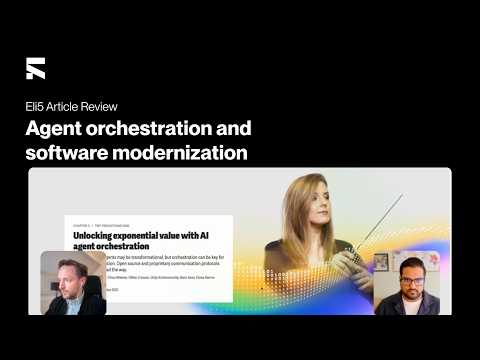
Unlocking Exponential Value with AI Agent Orchestration
Source: Deloitte Insights
Abstract. As companies move toward multi-agent systems where different AI engines interact across domains, orchestration becomes essential. Market estimates suggest the autonomous AI agent market could grow significantly if enterprises improve their readiness to coordinate these agents.
Review and Insights. Deloitte focuses on the market size, but we focus on the risks of poor technical groundwork. A sophisticated autonomous agent layer cannot be built on top of a legacy system that does not allow for clean data exposure.
One model fallacy: We move away from the idea that one LLM will do everything. We view the future as an abstraction layer where models can be swapped. For example: Gemini for writing, Claude for coding, without refactoring the entire core product.
Architecture gap: While many feel mature in basic automation, few are ready for agents. Our experience shows that agents require a modular, metadata-driven architecture, not just a smart overlay on top of old workflows which creates security and integration issues.
Autonomy spectrum: We predict a shift from Humans in the loop to Humans on the loop, but this requires a robust context layer that translates diverse data into structured knowledge like ontologies or knowledge graphs.
The Hidden Cost of Waiting for Best Practices in AI Adoption
Source: CIO
Abstract. Many organizations are delaying AI adoption until industry-wide best practices and how-to guides are fully documented. This article argues that AI is following a technology script where early adopters gain a lead while cautious organizations find themselves in a state of catch-up.
Review and Insights. We see waiting for a playbook as a form of competitive erosion rather than safety. In our discussion, we noted that most organizations use governance as an excuse for inaction, only to later deploy rushed, poorly understood implementations under market pressure.
Literacy: We believe urgency is not about replacing jobs but about becoming AI-literate before the landscape shifts completely. If an organization is not building institutional intuition through early experimentation, it is effectively choosing to remain ignorant while competitors learn by doing.
Profitability: Our take is that late adopters eventually implement AI under margin pressure rather than for a competitive advantage. While early movers use AI to improve margins, laggards will eventually be forced to use it just to defend shrinking ones.
Obsolescence: We argue that boards no longer need technical experts; they need leaders who can translate AI complexity into strategy. Leaders who avoid AI today are quietly reducing their future relevance because those who understand AI will inevitably replace those who do not.
Lenovo Pushes AI Orchestration as Agent Market Intensifies
Source: TechInformed
Abstract. Major tech players like Microsoft, Salesforce, and Google are racing to dominate the agent market. Lenovo has entered the market with an end-to-end approach designed to deploy and manage AI agents across organizations.
Review and Insights. The tech giants are building walled gardens. At Eli5, we advocate for interoperability and open gateways so organizations are not locked into a single provider's ecosystem.
Orchestration vs. IQ: We agree that the bottleneck is no longer intelligence but orchestration. The real ROI comes from designing solutions with a clear end goal, such as Lenovo’s iChain digital twin which reduced lead times and quality defects.
Worker agent stack: We find the AT&T approach particularly insightful: using LLM super agents to direct smaller, cheaper worker agents. This led to a 90% cost saving, proving that the architecture of the orchestration layer is more important than the size of the model itself.
Full video episode: agent orchestration and software modernization
The first step to start the modernization journey
Software modernization and architectural rebuilds lie at the heart of Eli5. We solve complexity to deliver direct business value by focusing on pragmatic, cloud-native transitions.
Before deciding whether to wrap the legacy system, buy a new SaaS product, or use AI to build custom tools, an organization needs total visibility into its current tech landscape.
Interested in booking a free brainstorm to discuss the legacy stack? It is the essential first step to turning technical debt into a scalable, modular future.