Eli5 article review series: LLM assisted software modernization

This week, we reviewed articles regarding LLM support for legacy software modernization.
There is a wave of application rebuilding and replacement going on. At Eli5, we review articles about software modernization every week to find real value for CTOs, PMs, and POs who have to deal with the modernization of legacy software.
Rethinking software modernization in the age of generative AI
Source: Forbes.com
Abstract
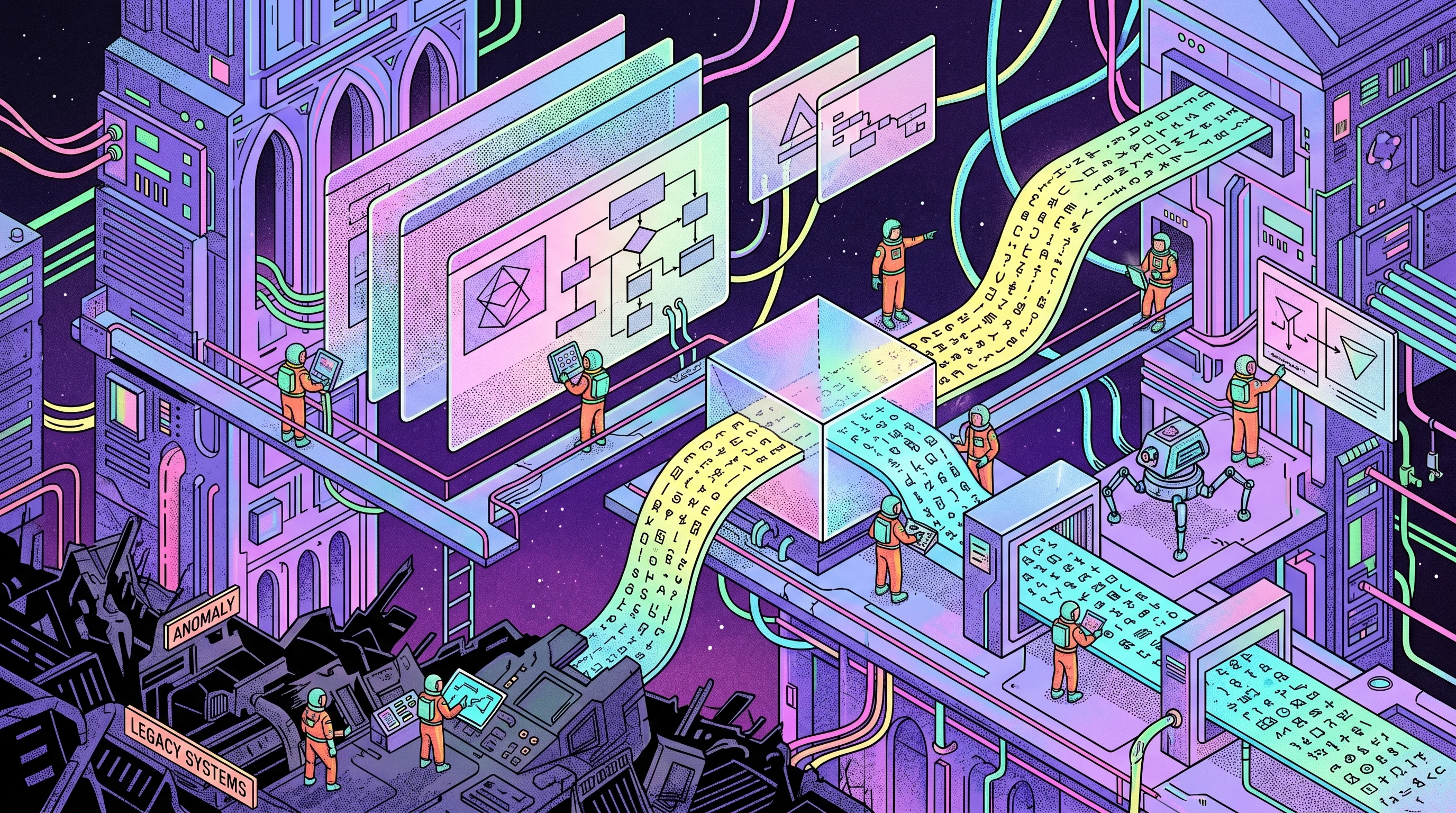
The core problem with legacy systems is not necessarily their age, but their opacity. Because nobody knows how these systems work anymore, GenAI is positioned as a tool to capture the "intent" of the old system before writing any new code.
Review and insights
In exploring legacy applications, a development team often spends the majority of its time figuring out what a previous developer was trying to do. While GenAI cannot "know the mind" of the original author, it provides essential talking points to help us understand the constraints and choices of the past.
The main insight from our discussion is treating the LLM as your modernization peer:
- Don’t let the AI read for you; read with it: If an LLM simply summarizes code for you, your own understanding doesn't actually improve. It is like someone reading a book to you; you absorb much less than if you read and discuss it yourself.
- The "exchange of vision": Treat the LLM as a colleague for code reviews. Share your understanding of a piece of code and use the LLM to verify assumptions or find entry points you may have missed.
- Scoping the analysis: For large systems, do not try to understand the full application at once. Break it down into contained modules or functionalities to validate the small parts before seeking a "helicopter view" of the interconnection.
Concluding remarks
We rate this article a 7/10. It makes strong points regarding transparency and intent, though it transitions into a sales pitch toward the end.
Modernizing legacy architectures using GenAI-powered knowledge graphs
Source: Nasscom.in
This article explores using GenAI to create knowledge graphs and visual mappings of legacy dependencies and infrastructure.
Review and insights
While LLMs can generate visual diagrams (like Mermaid) to map a landscape, this approach is often surface-level. It provides a snapshot of "what" is there now, but fails to explain "why" the architecture evolved that way.
Crucial hurdles discussed include:
- The "shitty foundation" risk: Rebuilding a front end without addressing the back end is like renovating a house's facade while the foundation is failing. You cannot build a new floor on top of a legacy system if the foundation doesn't allow it.
- Loss of context: LLM accuracy can lower as context windows fill up, causing the model to ignore or dilute parts of the application.
- The "black box" of data: Using personal LLM plans means your data is used for training. For security, we utilize specific APIs that guarantee data is not used for training invocations.
Concluding remarks
We rate this article a 5/10. It provides snapshots for documentation but offers little substance on the practical side of modernization
Unleashing developer productivity with generative AI
Source: McKinsey.com
Abstract
Research on how GenAI affects developer speed and happiness, highlighting that senior developers gain significant velocity while junior developers may struggle in complex environments.
Review and insights
GenAI significantly increases happiness when handling "boilerplate" or lower-level tasks, such as scaffolding an MVP or writing unit tests. However, there are significant long-term concerns:
- Diminishing returns on complexity: When complexity is high, LLMs contribute almost nothing because they lack the specific business rules and organizational context held by senior developers.
- The junior developer gap: Since seniors are using AI for simpler tasks instead of delegating them, junior developers are losing the opportunity to be trained on the nuances of company-specific frameworks and business rules.
- Viability and dependency: Relying on private LLMs creates a difficult dependency; if a provider sunsets a product your business relies on, your business is at risk.
Concluding remarks
We rate this article a 6.5/10. While the research on productivity is valuable, it is not fully adjusted for the complexity of deep legacy modernization work.
Full video episode: LLM as a colleague in software modernization
The first step to start your modernization journey
Software modernization and architectural rebuilds lie at the heart of Eli5. We solve complexity to deliver direct business value by focusing on pragmatic, cloud-native transitions.
Before you decide whether to wrap your legacy system, buy a new SaaS product, or use AI to build custom tools, you need total visibility into your current tech landscape.
Would you like to book a free brainstorm to discuss your legacy stack? It is the essential first step to turning your technical debt into a scalable, modular future.







.webp)






.webp)
.webp)



















.webp)

.webp)


.webp)



%20(1).webp)


.webp)
.webp)


