Esoteric Principles for Entrepreneurs

Every startup founder and tech entrepreneur is flooded with business books, productivity frameworks, and Huberman protocols for optimal performance. But what if the most powerful edge isn't found in conventional approaches but in esoteric principles that sound too strange to work? I used to be one of these people and have read all of the literature all founders and techies have in their library. From 'The $100 Dollar Startup' and 'The Lean Startup' to 'From Zero to One' and 'The Hard Thing About Hard Things', all of them have been valuable in their own way but did they really make a difference? Or was it just some form of procrastination? In the last 12 months, I've traded startup theory for esoteric mental models, and they've moved the needle more than any business book ever did.
One book stood out: Reality Transurfing by Vadim Zeland. I read it with skepticism. And maybe that's why it worked. I didn't try to believe, I just paid attention and followed his advice. What it comes down to is that every possible lifeline is out there to be lived. One closer to the current situation than the other, but it's all out there waiting to be lived. From lifelines where a person has it all to lifelines full of misery. Vadim calls it the Alternatives Space. Think of it as a quantum multiverse or the Many Worlds Theory: every version of a life already exists. The only difference is that, according to Zeland, a person has full control over their lifeline and is not bound to a specific universe they're living in. Every possible lifeline already exists, it only takes stepping into the one that aligns with the reality worth living.
The Alternatives Space
See the alternatives space as a large grid of pixels, with the current self at the bottom in the center. The pixels on top are further in the future and the pixels on the bottom are about to unfold. The closer the pixels are to that self, the more likely they will be turned from metaphysical to physical. Each pixel represents a part of a possible lifeline. There are pixels completely in line with an imagined perfect life, but also numerous pixels that are filled with stress, anger, illness, or worse.
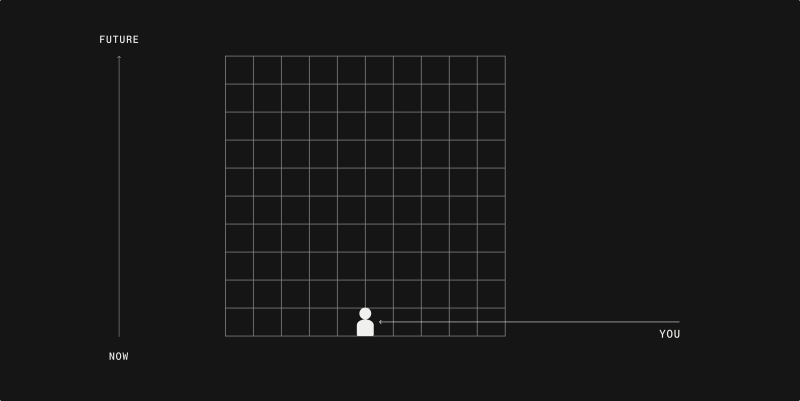
It's fair to wonder why this is important to understand. The point is that a person literally decides what the next pixel is that will unfold. Most likely some kind of reference to the idea of our thoughts shaping our realities is already familiar. From Earl Nightingale's notion that a person becomes what they think about to the Bible's "As a man thinketh, so is he" (Proverbs 23:7), the idea that thoughts shape reality has been echoed for centuries. According to Vadim, our thoughts will align us with the next pixel. The more focus goes to things that cause anger, the more of it arrives. The more focus goes to love and health, the more comes from it. The universe does not care about good or bad, it gives more of the thing one is most conscious about. This idea is a core component of the more spiritual philosophy of 'The Law of Attraction' but also leads us to the great philosopher Carl Jung. Jung believes, as he laid out in his book Synchronicity, that the psyche and physical reality are connected by meaning, not causality. Think of those moments where thoughts, dreams, or emotions seem to magnetize external events.
Let's assume that the universe's energy flows through us and the thoughts we have are manipulating the energy that flows through us. Once the energy leaves, it sends out the energy it has been given and it will align the next pixel with the energy being broadcast.
Resistance and Pendulums
Just having more positive thoughts is, of course, way easier said than done. There are many forces that constantly try to throw a person off balance, think of social media and the news, haters and critics, or things like shiny object syndrome. Steven Pressfield thinks similar about this, in his book 'The War of Art' he refers to this as Resistance. He writes that Resistance will say anything to keep someone from doing the work; it will perjure, fabricate; it will seduce. "Resistance is always lying and always full of shit." Vadim calls this phenomenon 'Pendulums'.
Pendulums are collective thought structures or energetic entities that feed on the attention and emotional energy of people. It starts small, but grows stronger as more people align with it through fear, love, hate, support, or resistance. They don't care if the energy is "positive" or "negative," as long as someone is hooked.
A pendulum can be something innocent like a software development company, or it could be politics or even worse, war. Vadim's Pendulums or Pressfield's Resistance have a lot in common and that is to prevent a person from living the life they want to live. It's so easy to getting sucked into a politically loaded conversation, the next industry related FOMO, or social movements.
Freedom never arrives until an organization stops reacting to these, whether this is positive or negative. As might already be clear, there will always be some form of a pendulum at play. From the company a team works for to the local community it operates in. The best way to disengage from a pendulum is to stay aware, reduce emotional involvement, and move in one's own direction with pure intention. As long as the pendulum serves the organization, like a company, then move with it. But always with awareness and minimized emotional involvement.
Why caring too much breaks everything
There's a paradox every founder knows but rarely discusses: the deals a team desperately needs never close, while the ones approached casually often do. The pitch practiced obsessively falls flat, but the informal conversation at a coffee shop leads to something great. Zeland believes this isn't random and thinks that the importance attached to things is causing this.
Today, grind is still recognized as the key approach to get where a team wants to go. From hustle culture and the 5AM club to everything taught at school, we're conditioned to force results through effort. We brute-force our way to product-market fit, grind all day everyday, and want recognition for the insane effort we put in. That's still better than doing nothing. But what if the grind could work better if it wasn't so heavy-handed?
When we make something too important, we create an energetic imbalance. Zeland calls this "Excess Potential". Reality corrects these imbalances, usually by blocking exactly what we're forcing. Think about those meetings where the team told itself, "This HAS to go well, or we're dead." Undeniable tension. The pitch felt rehearsed. The questions threw everyone off because of the attachment to a specific outcome.
Now contrast that with a casual coffee meeting where the business simply came up. No pressure, no rehearsed elevator pitch. Just authentic conversation about a problem being solved. Those meetings often lead somewhere because there's no excess potential disrupting the flow.
This connects quite well to something probably more familiar: Stoicism. The Stoics figured important things out 2,000 years ago that remain powerful today. Marcus Aurelius wrote about focusing only on one's actions, not their outcomes. The Stoics called it preferred indifferents. A team can prefer success, wealth, or recognition, but its peace of mind can't depend on getting them.
Transurfing says the same thing with different language: have clear intention about the direction, but hold the outcomes lightly. Both teach that excessive desire creates resistance. There is a key difference, though. Stoics practiced negative visualization, imagining loss to reduce attachment. Transurfing would say this is dangerous because it means focusing on unwanted pixels. Where attention goes, energy flows.
There's a crucial difference between high standards and high importance. High standards mean striving to deliver excellent work and having clear expectations of the things created. High importance means an emotional state that depends on specific outcomes.
The key is wanting something without needing it. When pure intention combines with low importance, the grind stops being a struggle. The gliding starts. There's no energetic imbalance being created to block the intended lifeline.
What we just described is, according to Zeland, all inner intention. The grinding, the forcing, even the Stoic detachment. It's all about managing the internal approach to getting what one wants. Now we're going to talk about outer intention. This is where things get interesting.
Intention is not just wanting something
According to Transurfing, there is a far more powerful form of intention: 'Outer Intention'. It's what happens when a team aligns so clearly with its desired lifeline that reality starts coordinating with the team, rather than the team forcing its way through reality.
Outer intention emerges when a team stops trying to control how things unfold and starts trusting the process. It's the thing that produces a flow state where everything clicks. It's the state that creates those moments when the right person calls at the right time, when solutions appear without forcing them, and when opportunities seem to magnetize toward the operation.
Here's where most people get Transurfing wrong. They read about outer intention and desired lifelines and think it's like modern spiritual clickbait. Take The Secret, which sells the illusion that visualizing alone will make the universe bend to a person's will. That's not Transurfing at all, that's just wishful thinking.
Zeland is clear about this: intention equals desire plus action. Both components are required, otherwise it's just daydreaming. Desired reality without action is hoping. Action without clear direction is just busy work. Intention is the marriage of both.
The key, according to Zeland, is to focus on taking the next step, not leaps. Most founders have figured out all the steps to reach their desired end result. A well-defined plan to go from idea to IPO plays on loop in their minds, and they get frustrated when reality doesn't cooperate. That's not how these pixels unfold. The end goal is worth keeping in mind, but the plans that lead there shouldn't be held too firmly.
The universe responds to energy, not dreams. Consistent action toward a desired lifeline shows the Alternatives Space that the intent is serious. Each step taken makes the next pixel in that direction more probable. When a team stays in motion, focusing on taking the next step, the universe will meet it halfway. The path that eventually leads to the end goal will always be different than how it was imagined.
Gut feeling plays an incredibly important role here. Zeland calls it "the rustle of the morning stars"; most founders recognize this better as founder intuition. When things don't feel right, even though on paper everything looks good, it's worth listening deeply to what that gut is trying to say. When things do feel right, the feeling is just as clear. This will lead onto paths that could not have been imagined before they were taken. I guess it's worth trusting the universe a bit more.
Every founder with some years of experience under their belt knows this deep inside. The decisions I've made that made sense to everyone else and looked good on paper, but while my gut told me something was off, turned out to be terrible moves. The times people thought I was doing something stupid, while to me it felt like a great thing, unfolded surprisingly well. Derek Sivers captured this perfectly in 'Hell Yeah or No': "If I'm not saying Hell Yeah! about something, then I say no." We're getting more and more out of tune with our gut, all while it tells us so many important things.
The difference between inner and outer intention is profound. Inner intention says "I will make this happen." Outer intention says "I allow this to happen, and I'm coordinating with how it wants to unfold." Both require action, both require clarity, but the energy behind them is completely different. Inner intention should be channeled towards managing thoughts, being aware of what the gut says, and making sure the team stays in motion while keeping the desired goal in mind. Outer Intention is the thing that will carry the operation there in the most efficient way.
Surf, don't scramble
Most founders approach challenges like boxers. They meet every problem with force, trying to punch through obstacles. But what if there was a more elegant way? What if a company could navigate business like a surfer, reading the waves and riding them instead of fighting them?
Life isn't linear or mechanical. It's rhythmic and dynamic. Zeland calls this coordination of intention. It's choosing how to respond to events while staying aligned to the desired lifeline. It's not about passive acceptance. Those that let reality happen will mostly end up unsatisfied. It's about using the flow and steering in a controlled manner and with full intention towards the intended destination.
Let's say a terrible sales month hits. The boxer mentality kicks in: panic, tighten up, start making desperate moves, send aggressive follow-up emails, slash prices to force deals. This reactive energy often shifts the company to a worse pixel. One that is aligned with desperation and anxiety.
The surfer mentality is different. The bad month gets acknowledged without being made to mean everything. The team stays present, analyzes what's actually happening, and adjusts the approach while maintaining a longer-term direction. Maybe this downturn is revealing a product-market fit issue that needed addressing anyway. Maybe it's clearing space for better clients who are already in the pipeline.
The goal is movement with clean intention and clear awareness. It's not about fighting reality or trying to force it into a timeline but merely coordinating with it. Staying flexible in the path being taken while remaining firm in the destination.
This is especially crucial in startup operations. Founders often confuse panic with urgency, and urgency with productivity. But there's a rhythm to building companies that panic disrupts. Revenue has seasons. Team dynamics have cycles. Product development has a natural cadence. When teams learn to surf these rhythms instead of fighting against them, everything becomes more effortless.
How I apply this daily
Anyone reading this far probably doesn't believe this is some woo-woo. To me it's a tactical mindset system I use daily. Here's the simple framework that has moved the needle more than any business book.
Morning Coordination (10 minutes):
This only takes ten minutes. Waking up 10 minutes earlier or doing it in the shower - whatever fits the routine - is enough. It works just as well while walking or just sitting in a lazy chair, as I do.
Awareness Check: What pendulums are trying to hook me? Is it the X outrage cycle, some hiccups in ongoing partnerships, or that critical client email? I identify them without judgment, just awareness.
Lifeline Alignment: I spend two minutes visualizing the version of reality where I already live in my desired reality. Just the calm, focused founder who has already solved his problems.
Action with Low Importance: I choose my top three actions for the day, but I hold them lightly. High standards for execution, low attachment to specific outcomes. I want these things to work, but I don't need them to work in exactly the way I imagine.
Throughout the day:
When I notice resistance or things feeling forced, I pause and ask: "Am I boxing or surfing right now?" Usually, I'm boxing. The simple recognition helps me adjust my energy and approach.
Evening Reflection:
What flowed today? What felt forced? Where did I get hooked by pendulums? No judgment, just data for tomorrow's coordination. I practice to be grateful for the things in my life and to say a little prayer for those around me.
The entire system takes maybe 15-20 minutes a day, but it's changed how I navigate everything from difficult conversations to product decisions.
Awareness, not magic
Look, I get it. This sounds like Silicon Valley quantum physics meets some esoteric rabbit holes. But strip away the metaphysical framework, and what's left is something every founder needs: better awareness of how mental state affects results.
Whether one believes in Transurfing or not, this part is hard to argue with: the energy brought to situations matters. Attachment to outcomes affects performance. The ability to stay present during chaos impacts decision-making. These aren't just mystical concepts but can also be seen as practical intelligence.
Every founder optimizes for leverage. Founders look for ways to get more output from less input. They automate systems, delegate tasks, and find tools that multiply their efforts. This is nothing but optimizing the operating system between their ears.
Carl Jung wrote, "Everything that irritates us about others can lead us to an understanding of ourselves." The irritating pendulums, the forced situations, the importance we attach to outcomes. They're all pointing us toward better self-awareness.
Marcus Aurelius understood this 2,000 years ago, writing that power lies over the mind, not over outside events, and that realizing this is where strength is found. Vadim just packaged ancient wisdom in a framework that resonates with how we understand reality today.
Try it. Not to believe it, but to see if it works. Spend a week paying attention to mental state before important meetings. Notice when boxing is happening versus surfing. Observe how pendulums try to hook attention. See if coordination feels different than force.
The worst that happens? Greater awareness of how thoughts affect actions. The best that happens? The discovery that reality is far more malleable than any business book ever suggested.
The first step to start your modernization journey
Software modernization and architectural rebuilds lie at the heart of Eli5. We solve complexity to deliver direct business value by focusing on pragmatic, cloud-native transitions.
Before you decide whether to wrap your legacy system, buy a new SaaS product, or use AI to build custom tools, you need total visibility into your current tech landscape.
Would you like to book a free brainstorm to discuss your legacy stack? It is the essential first step to turning your technical debt into a scalable, modular future.
 Wes Botman