The CAPEX and OPEX of software modernization

Rebuilding or refactoring legacy systems requires a substantial initial investment. For many organizations, securing the capital expenditure (CAPEX) is seen as the primary hurdle. We believe the true test of a successful modernization project comes immediately after: the decision to invest in CAPEX must be followed by a well thought out strategy for Operational Expenditure (OPEX).
In the past, we saw a tendency to "build and forget." A system was launched, and the investment stopped there. Today, the pace of progress in software and hardware creates immense security and operational risks for stagnant systems. From an OPEX perspective, bare-minimum active maintenance is no longer just a nice-to-have*; it is an absolute necessity to protect the initial investment.
*it never was a nice-to-have, but the risk of ignoring maintenance was lower when applications were more standalone.
Beyond keeping the lights on, most applications, and the companies that run them, require a second tier of OPEX investment focused on continuous improvement. A modernized product must remain dynamic to stay competitive. This ongoing investment fuels important technical advancements like AI integration, elevates the overall user experience, and allows for the seamless rollout of new features that meet evolving market demands.
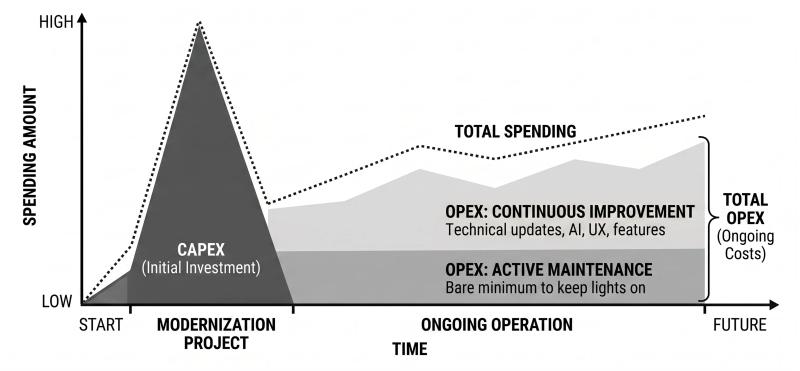
CAPEX and OPEX of software modernization
Fortunately, securing software does not have to be an overwhelming burden. Active maintenance can often be executed successfully with limited resources. More than anything, it simply requires a firm management decision to clearly distribute responsibility, ensuring that someone is accountable for the day-to-day health of the software.
Conversely, deciding how much capital to allocate toward continuous improvement requires a concrete business case. This ongoing investment must be measured and justified by two distinct metrics: a tangible Return on Investment (ROI) in monetary value, and a qualitative return measured by the happiness and satisfaction of the organization's clients, customers, and employees.
Ultimately, to avoid falling into the same legacy trap years down the line, decision-makers must establish their post-software modernization strategy before the actual build even begins. This strategy is built on two pillars: active maintenance, which is entirely out of the question to skip, and a well-defined, sustainable plan for continuous improvement.
The first step to start your modernization journey
Software modernization and architectural rebuilds lie at the heart of Eli5. We solve complexity to deliver direct business value by focusing on pragmatic, cloud-native transitions.
Before you decide whether to wrap your legacy system, buy a new SaaS product, or use AI to build custom tools, you need total visibility into your current tech landscape.
Would you like to book a free brainstorm to discuss your legacy stack? It is the essential first step to turning your technical debt into a scalable, modular future.