The budget estimation paradox: the unsolved challenge in agile methodology

Imagine an organization planning a road trip from Amsterdam to Rome. The request to the travel agent goes like this: "We want to visit three countries and see some historic sites along the way. What will this cost exactly?" The agent can estimate fuel, hotels, and basic expenses, but they know the real journey will unfold differently. Will the travelers discover that charming village in Switzerland that wasn't on any map? Extend the stay in Florence because the art museums captivated them? Take a detour to avoid construction, only to stumble upon a medieval festival? The most memorable trips aren't the ones that stick rigidly to the original itinerary.
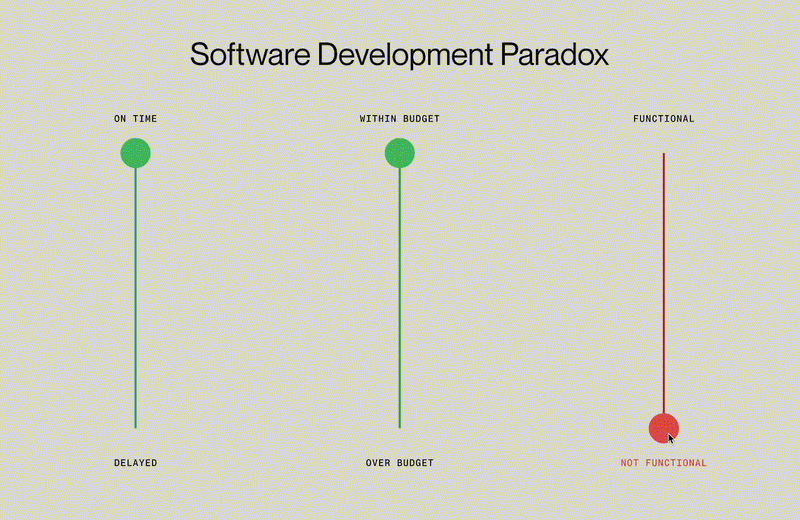
Software development follows the same unpredictable pattern, yet clients consistently ask agencies for fixed price estimates on agile projects. Software development operates under an iron triangle constraint: a project can be delivered on time, within budget, or fully functional - but never all three simultaneously. This isn't a failure of planning or skill; it's the fundamental physics of creative problem-solving work. When clients demand fixed budgets, something else must give way. The reasonable demand for upfront cost clarity fundamentally conflicts with agile's core principle: building user-centered products requires continuous discovery and adaptation. This creates an unavoidable paradox that trips up both agencies and clients, leading to outcomes that satisfy no one.
The MVP estimation sweet spot (and why it doesn't last)
Here's what most people don't realize: agencies can actually estimate MVP budgets quite accurately. When a senior architect analyzes requirements and designs preliminary solution architecture, they can typically provide MVP estimates within ~25% accuracy. That €200,000 budget estimate might realistically become €250,000, with the agency absorbing that €50,000 overrun due to the fixed fee agreement, but it won't balloon to €400,000 if the scope stays true to the original vision.
The MVP holds most of the "Must Have" features that define the product's core value. These are well-understood problems with established solution patterns. Need user authentication? There are proven approaches. Want payment processing? The technical requirements are clear. Building a content management system? Agencies have done this hundreds of times.
The real challenge starts after MVP launch. Once real users are interacting with the product, everything changes. It becomes clear that users behave differently. Features assumed to be essential go unused, while throwaway prototype elements become the most loved parts of the app. The roadmap meticulously planned six months ago suddenly feels disconnected from market reality.
How post-MVP development actually works
The sprints following MVP focus on expanding Must Have features and introducing Should Haves, but here's the crucial difference: the exact work filling these sprints becomes fluid and collaborative. While the development agency provides estimates for the number of sprints needed to reach the Minimum Marketable Product (MMP), what gets built in each sprint evolves based on user feedback, market response, and technical discoveries.
This isn't poor planning. It's the fundamental strength of agile development. Time and money can be redirected to opportunities that emerge along the way without derailing the project. Maybe users are demanding mobile app functionality that wasn't in the original spec. Perhaps a competitor launches a feature that forces a pivot of the differentiator. Or the team discovers a technical integration that could reduce onboarding from five steps to one.
Traditional fixed price contracts treat these changes as costly scope creep. Agile approaches treat them as valuable course corrections that increase the product's market success. The question isn't whether changes will happen; it's whether the contract structure punishes or rewards intelligent adaptation.
Why traditional contracts break down
The deepest issue with fixed fee software development isn't budgeting. It's that the definition of "done" can't be contractually arranged from the project start. Key functionalities and jobs to be done can be defined, but the specific implementation details that determine user satisfaction only emerge through iterative development and testing.
Consider Netflix's recommendation engine. The job to be done is simple: "Help users discover content they'll enjoy." But the actual algorithm involves hundreds of variables, from viewing history and time of day to device type and social signals. Netflix couldn't have specified these requirements upfront in 1997; they discovered them through years of user behavior analysis and experimentation.
This creates an inevitable tension in fixed price agreements. At some point, the fixed fee arrangement must transition to a paid-per-sprint or resource model to remain viable for both parties. Smart agencies plan for this transition from the beginning, structuring contracts that provide budget certainty for MVP while enabling collaborative development for everything beyond.
Why clients make the same expensive mistakes
Here's what happens in most agency-client relationships: The client, burned by previous projects that spiraled out of control, demands a fixed price contract for "protection." They believe that locking in costs upfront eliminates risk. The agency, knowing they can't predict every twist and turn of software development, quietly adds 15-25% to their estimate as insurance against the unknown.
Both parties think they're being smart. The client gets their predictable number. The agency gets their safety buffer. But here's the cruel irony: this "protection" often costs more than the flexibility it's meant to avoid. When agencies can't adjust scope based on what they learn during development, they pad estimates to cover worst-case scenarios. Organizations end up paying for problems that never materialize while missing opportunities that could have transformed the business.
The same flawed thinking drives another common mistake: believing that detailed upfront planning reduces costs. Clients often demand exhaustive specifications before a single line of code is written, thinking this eliminates uncertainty. Agencies, eager to demonstrate thoroughness, produce dozens of pages documenting every conceivable feature and user interaction.
This feels responsible, but it's actually counterproductive. Software isn't like constructing a building where exact materials and proven engineering approaches can be specified. Buildings have foundations that don't change based on how people use the upper floors. Software development involves continuous problem-solving where each decision creates new possibilities and constraints that couldn't be foreseen at the start.
The agencies that consistently deliver the best value understand this fundamental difference. They invest heavily in discovery phases, not to eliminate uncertainty, but to understand it better. They recognize that detailed task-level estimates for creative work create false confidence that ultimately hurts both parties. Requirements will evolve during development, and the question isn't whether to plan for this reality, but how to structure agreements that turn inevitable changes into competitive advantages.
The path forward: Embracing uncertainty as competitive advantage
The agencies that thrive in this environment don't fight against uncertainty. They turn it into a competitive advantage. They structure contracts around outcomes rather than specifications, measure success by user value rather than feature completion, and treat budget estimates as collaborative planning tools rather than binding predictions.
For clients, this means shifting from "What will this cost?" to "How can we maximize value within our budget constraints?" For agencies, it means developing transparent communication systems and risk-sharing models that align incentives with client success.
The paradox isn't going away. Agile development will always conflict with fixed price certainty because the methodologies serve fundamentally different goals. But understanding this tension, and structuring agreements that work with it rather than against it, leads to better products, stronger relationships, and more successful outcomes for everyone involved.
The question isn't whether a fixed price for custom software development is available. The question is whether the goal is a price that reflects the true value of what's being built, or just a number that feels temporarily comfortable before reality sets in.
AI is reshaping the budget estimation landscape
The emergence of AI development tools is beginning to shift this entire dynamic in unexpected ways. Clients can now create functional prototypes using tools like Bolt and Cursor, arriving at agency meetings with working demonstrations rather than abstract concepts. This represents a fundamental change in how projects begin.
When non-technical stakeholders build semi-functional MVPs themselves, they provide agencies with clearer requirements baselines and concrete interaction models. Instead of translating vague business concepts into technical specifications, agencies can examine actual functionality and user flows. This tangible starting point dramatically reduces the uncertainty that traditionally plagued early-stage estimation.
When clients arrive with working prototypes, agencies spend significantly less time on discovery and requirements clarification phases. Technical feasibility becomes partially validated before formal development begins, and scope definition transforms from abstract discussion to concrete enhancement planning. The dreaded "we thought this was what was meant, but something else was actually wanted" conversations become far less common.
This shift is also changing what agencies actually do for their clients. Agency expertise focuses on complex integrations, scalability architecture, and production-ready systems that require deep technical knowledge. Quality assurance and security validation become larger budget components, as AI-generated code needs professional review to meet enterprise standards. The agency value proposition evolves from "we'll build the idea" to "we'll make the AI-assisted prototype into a robust, scalable business system."
The first step to start your modernization journey
Software modernization and architectural rebuilds lie at the heart of Eli5. We solve complexity to deliver direct business value by focusing on pragmatic, cloud-native transitions.
Before you decide whether to wrap your legacy system, buy a new SaaS product, or use AI to build custom tools, you need total visibility into your current tech landscape.
Would you like to book a free brainstorm to discuss your legacy stack? It is the essential first step to turning your technical debt into a scalable, modular future.
 Floris Schoenmakers